Reliance Roofing Raleigh provides Roofing in Raleigh, NC.

A roofing company in Raleigh, NC is a local contractor that inspects, repairs, and replaces residential roof systems, shingles, underlayment, flashing, valleys, decking, and ventilation, on homes throughout Raleigh and Wake County.
Every service reflects the same meticulous attention to detail, whether it's a single job or a larger roof project across Raleigh.

Roof leak repair is our most-requested service in Raleigh, and most active leaks trace back to five places: pipe boots that cracked in the sun, step flashing at a chimney or dormer, a valley clogged with oak and pine debris, nail pops, or shingles lifted by storm wind. Finding the real entry point matters because water runs downhill along the decking before it drops through the ceiling, so the stain in your hallway is often several feet from the hole. We inspect from the attic side as well as the roof side, show you photos of what we found, and repair the actual source instead of smearing sealant on a guess. Most single-point repairs are a same-visit or next-visit job once the roof is dry enough to work on safely, and we'll tell you plainly if the leak we found is a symptom of a roof that's simply finished rather than a roof that's broken in one spot.
Get a quote →
Full roof replacement covers complete tear-off of the old shingles down to the deck, replacement of any soft or delaminated plywood, new synthetic underlayment, new ice-and-water membrane in valleys and around penetrations, new drip edge, new flashing, ridge ventilation, and haul-off of every scrap. Tear-off matters because it's the only way to catch rotten decking under an old roof, common on 1940s, 1960s houses around Five Points, Hayes Barton, and Boylan Heights that have been re-roofed more than once. Most Raleigh homes are a one-day or two-day job. We tarp the shrubs and the AC unit, keep debris out of the flower beds, and sweep and magnet-roll the yard and driveway before we leave, because a nail in a tire undoes a good roof job fast. Roof replacements in Raleigh generally require a permit from the City of Raleigh, and we handle that paperwork as part of the job so you're not chasing it.
Get a quote →
Storm damage assessment is a documented roof inspection after wind, hail, or a hurricane remnant moves through central North Carolina. We photograph bruised or fractured shingles, creased tabs, lifted ridge caps, dented soft metals like vents and gutter aprons, and any collateral damage, then give you a written summary you can hand to your insurance adjuster. Documentation matters because hail bruising is often invisible from the ground and adjusters work from evidence, not opinions. Timing matters too, most policies expect damage to be reported within a defined window after the storm date, so an inspection in the days after a hailstorm is worth more than one six months later. We'll tell you honestly whether the damage looks claim-worthy or whether it's a cheaper out-of-pocket repair, and we'll meet the adjuster on-site when you want a second set of eyes up there.
Get a quote →
Emergency roof tarping stops water from entering while a permanent repair is scheduled, which is what you need at 8 p.m. on a Saturday with rain still coming. We secure heavy-duty tarp over the compromised area, anchor it so wind off an open lot doesn't peel it back, and get photos of the underlying damage while we're up there for your records and your claim. Tarping matters because interior damage compounds fast, wet insulation, stained drywall, and warped hardwood cost more than the roof repair itself. A tarp is a bandage, not a fix: it buys days or weeks of dry ceiling while materials are ordered and the weather clears. Call (984) 391-3020 and text a photo if you can safely take one from the ground, never climb up in the rain to get it.
Get a quote →
A roof inspection is a slope-by-slope walk of the roof plus an attic check, ending in a written condition report with photos and an honest remaining-life estimate. Inspections matter most in three situations: before you list a Raleigh house, after you go under contract on one, and after any storm that dropped limbs in the neighborhood. We look at shingle wear and granule loss, flashing at every penetration, valley condition, ventilation balance, nail exposure, decking sag, and signs of past leaks that were patched instead of fixed. A general home inspector reports what he can see from a ladder or the ground; a roofer reports what the roof is actually doing. You get the report whether or not you hire us for the work, it's yours to use with a buyer, a seller, or an insurer.
Get a quote →
Architectural asphalt shingle installation is the most common roofing choice in Raleigh, and for good reason: strong wind ratings, a wide range of colors that fit both older Mordecai bungalows and newer Wakefield two-stories, and repair parts that are easy to source years later. Shingle choice matters when your lot is exposed or heavily shaded, higher wind-rated laminated shingles hold up better on open sites near Brier Creek, and algae-resistant shingles are worth the small upcharge on the shaded north slopes common under Raleigh's oak canopy. We install to manufacturer specification on nailing pattern, starter course, and ventilation, because that's what keeps the material warranty intact. If your HOA in Stonehenge or Falls River has an approved color list, bring it to the estimate and we'll pull samples that fit it instead of guessing.
Get a quote →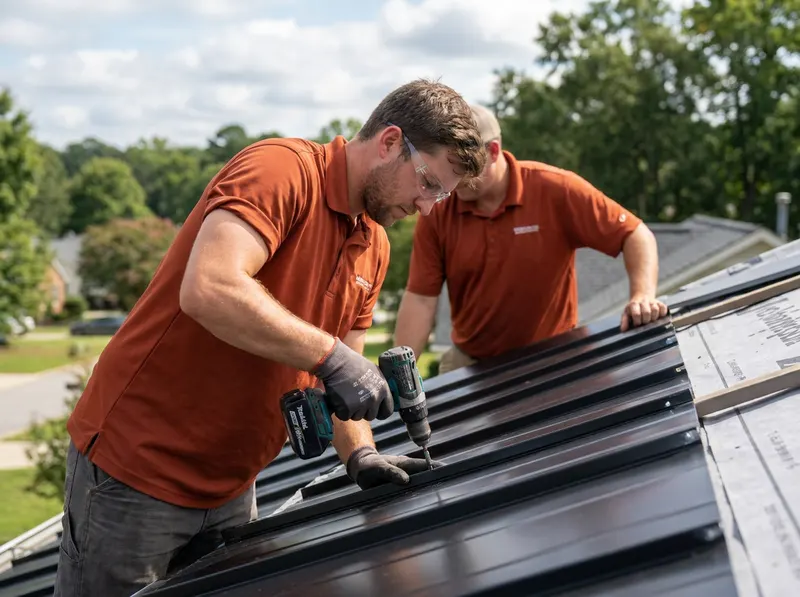
Standing seam and exposed-fastener metal roofing is the long-horizon option for Raleigh homeowners who plan to stay put. Metal matters when you're tired of pine straw and oak debris holding moisture on the roof, when your slope is low and shingles keep failing at the valleys, or when you want a roof measured in decades instead of years. Expect roughly 40, 50 years of service versus 25, 30 for shingles, and expect to pay two to three times more up front. Standing seam hides its fasteners under the seam, which is why it generally outlasts an exposed-fastener panel that relies on rubber washers; exposed-fastener metal costs less and suits a detached garage, shop, or porch better than a whole house. We'll walk you through panel profile, color, and how the metal will look next to your neighbors' roofs before you commit to the cost.
Get a quote →
Flashing repair covers chimney and sidewall step flashing, skylight re-flashing, pipe boot replacement, valley metal, counter-flashing, and drip edge. Flashing is where the majority of leaks on structurally sound Raleigh roofs actually begin, because it's the joint between two materials that expand and contract at different rates through a Carolina summer and a January cold snap. Flashing work matters most on houses with a brick chimney, a dormer, or an addition tied into the main roof, the exact profile of a lot of Historic Oakwood and Five Points homes. These are usually half-day jobs that cost a fraction of a replacement, and we'd rather sell you one than the wrong roof. If a previous repair relied on a thick bead of caulk instead of metal, we'll show you the photo and explain why it failed.
Get a quote →You get a firm, itemized quote for your roofing before any work begins, no surprises, no pressure.
Careful prep, tidy work, and a full cleanup when we are done. We treat your home and belongings like our own.
The same trusted, background-checked team from the first call to the final check.
The honest answer to "repair or replace?" depends on how much roof is failing, not on how bad one stain looks on the ceiling. If you have a single leak around a pipe boot, a chimney, a skylight, or a wind-lifted section on one slope, and the rest of the shingles still have granules and flexibility, choose a targeted repair, you keep $10,000 in your pocket and buy real years. If the roof is losing granules across every slope, the shingle edges are curling, and you're finding a third and fourth leak in different rooms, choose a full replacement, the trade-off is that piecemeal repairs on a worn-out roof stack up to a replacement's cost anyway, minus the new warranty and the clean start. As a rough dividing line: a roof under about 12 years old with damage on one plane is usually a repair; a 20-plus-year roof with widespread wear is usually a replacement, and anything in between deserves an inspection before anyone spends money.
On materials, the choice in Raleigh is mostly architectural asphalt shingles versus standing seam metal. If you want the lowest cost per year of protection and a color that matches the rest of the street in Falls River or Wakefield, choose architectural shingles, they typically carry 25, 30 year manufacturer ratings and cost roughly half to a third of metal per square. If you plan to stay in the house two decades, want a roof that shrugs off wind and pine debris, and don't mind spending two to three times more up front, choose standing seam metal, expect roughly 40, 50 years of service. The trade-off is simple: shingles win on budget and repairability, metal wins on lifespan and low maintenance. Three-tab shingles are the cheapest option and still exist, but their thinner profile and lower wind rating make them a poor fit for exposed lots near Brier Creek and the open ground around RDU; the small savings usually isn't worth it.
On scope, if a previous crew already added a second layer over the original, choose a full tear-off rather than another overlay, a tear-off lets us see and replace soft decking, which is where hidden rot in older Mordecai and Historic Oakwood homes shows up. If your roof has one layer, sound decking, and you're selling in six months, a partial replacement of the failing slope can be a legitimate, cheaper path. The trade-off is appearance and resale conversation: a partial replacement will not perfectly match aged shingles, and a buyer's inspector will note the difference.
There's a third fork most homeowners don't hear about: what to do with the low-slope sections. If you have a porch roof, a screened-in addition, or a dormer tie-in with almost no pitch, common on the additions built onto Boylan Heights and Mordecai houses over the decades, shingles are the wrong material there no matter how good the main roof looks. Choose a rolled or membrane system on those low-slope planes and shingles on the steep planes; the trade-off is two materials and one more seam to maintain, but it stops the recurring valley leak that keeps coming back every spring. And if your only real problem is heat and humidity in the attic, choose a ventilation correction before you choose a new roof, it's a fraction of the cost and it protects whatever roof you put on next. When we can save you money with a repair instead of a replacement, we say so in writing, that's the whole business model.
Every project gets a firm, written price after an on-site visit. Ranges below for orientation.
Tell us about your roofing job and we'll send a clear, written quote, usually the same day. Or just call and talk to a real Raleigh pro.
(984) 391-3020
Raleigh roofs age under a canopy, and that changes what fails first. Mature willow oaks and loblolly pines drop leaves, needles, and small limbs into valleys and behind chimneys, and that packed debris holds water against the shingles long after the rain stops, which is why so many Raleigh leaks start in a valley rather than in the open field of the roof. The same shade plus Carolina humidity produces the black algae streaking you see on north-facing slopes all along the streets off Glenwood Avenue and Six Forks Road; it's cosmetic, not structural, but it's the reason algae-resistant shingles are worth the small upcharge here. Raleigh's other reality is weather timing: spring hail and straight-line wind in April through June, then hurricane remnants pushing up through central North Carolina in late summer. After those events, phones ring across Wake County at once and honest crews get booked out, which is why we tell people to schedule a fall replacement four to six weeks ahead instead of waiting for the first cold rain. Housing stock matters too, the 1940s, 1960s homes around Five Points, Hayes Barton, and Historic Oakwood often hide plank decking and two or three layers of old roofing, while the newer builds out toward Brier Creek, Wakefield, and Falls River sit on open, wind-exposed lots near RDU where shingle wind rating and proper nailing do the heavy lifting. We work across the Beltline in both directions, from Boylan Heights and Mordecai near downtown to Stonehenge and North Hills, and we'd rather explain which of those conditions applies to your house than hand you a one-size quote.
 Reliance Roofing Raleigh